



Housebreaking your puppy is a crucial step in any puppy’s training, even if you plan on keeping it outside or in a kennel as it grows up. Housebreaking (or potty training), like crate training, is another way to introduce your puppy to positive reinforcement with patience and consistency. Avoid punishments if your puppy initially fails to learn toilet training commands.
You may wonder why you must housebreak your puppy if you plan on keeping it outside or in a kennel. First, if your pup doesn’t use its kennel as a bathroom, that means less cleanup for you.
Also, situations that require your dog to stay inside with you, such as travel, weather, or health problems that require low exercise and monitoring, may arise.
Adequately done, housebreaking should only take a couple of weeks. So how do you get started? Following these basic housebreaking procedures will make this portion of training a breeze.
Table of Contents
Establishing a Regular Schedule

Like raising a child, establishing a schedule is essential for your puppy. Your puppy should have a set time to eat, go out to potty, and play. Naturally, your puppy can control its bladder for one hour every month of age; for example, if it is four months old, he can hold it for about four hours.
Generally speaking, a puppy has to go to the bathroom within 5-10 minutes of waking up or eating, so take it outside immediately after it wakes up or gets done eating and wait with it until it goes.
Bodily functions also speed up during playtime, so taking your puppy out after playing is a good idea. Ways to help you establish a schedule include:
- Use a Consistent Feeding Schedule: Puppies are ferocious eaters, and your puppy may eat multiple times daily. Feeding at a consistent time will help ensure your puppy needs to go out consistently.
- Pick a Bathroom Spot: Dogs like to eliminate the same area repeatedly. Taking your puppy on a leash to the same spot will help it associate that area with using the bathroom. Also, the scent will help remind the puppy that it needs to go.
- Go Outside Often: Remember that your puppy has a small bladder with limited control over it. Therefore, you should take your puppy outside At least every two hours, immediately after waking up, eating or drinking, or playing.
- Limit Water Before Bedtime: Start putting up your puppy’s water bowl a few hours before bedtime. This will help eliminate accidents while you are sleeping.
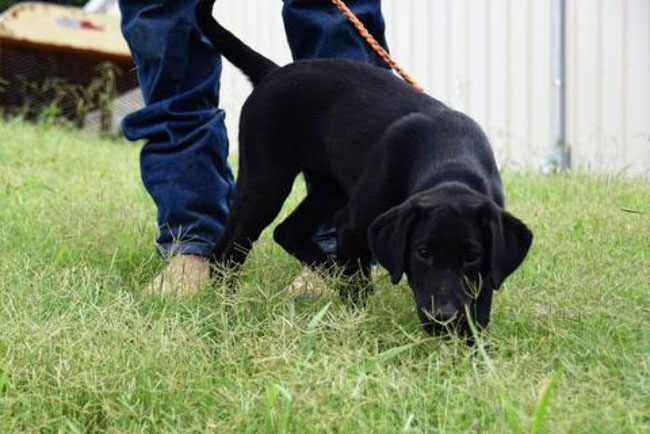
Taking Your Puppy Outside
-
- Use a Keyword: When you take your puppy outside, use a keyword, such as “potty,” while it is eliminating. Eventually, you can use it as a reminder when you take it outside.
- Pile on the Praise: Your puppy should associate good behavior with a reward. Some people like to give a treat; some people like to praise lavishly. We recommend both for the first few days because puppies are highly responsive to food, and it helps to associate praise with a reward. After that, however, we tend to put the treats away fairly quickly since food shouldn’t only motivate your puppy to please you.
Preventing Accidents

The best way to prevent accidents is not to allow your puppy to go to the bathroom inside. However, establishing a schedule goes a long way toward avoiding accidents inside the house.
Along with introducing a feeding schedule, limiting nighttime water consumption, and taking your puppy outside frequently, here are some other tips to help you prevent an accident from occurring.
- Supervision: When your puppy is inside, treat it like a baby just learning to crawl, and never let it out of your sight. Watch for warning signs that it may need to go outside. Some symptoms include restlessness, sniffing, squatting, or scratching at the door. Through a little simple observation, you will begin to pick up on these warning signs reasonably quickly.
- Confinement: You won’t always be able to keep an eye on your puppy. When you have to leave or when it’s time to sleep, keep your puppy confined to its crate. Puppies naturally don’t want to use the bathroom in a place where they sleep or eat. Always take your puppy directly to the yard when you let it out of confinement.
Conclusion
Housebreaking your puppy is a vital aspect of their training journey, regardless of whether they’ll primarily stay outside or in a kennel. Like crate training, this process fosters positive reinforcement through patience and consistency. Avoid punitive measures for initial failures and instead focus on guiding your puppy with understanding.
When taking your puppy outside, employ a keyword like “potty” and shower them with praise or treats upon successful elimination. Prevent accidents by closely supervising your puppy indoors, recognizing signs of needing to go outside, and using confinement, like a crate, when necessary.
For inevitable accidents, remain calm, avoid punishment, thoroughly clean the area, and redirect your puppy to their designated bathroom spot. Stay patient and consistent in your approach, rewarding desired behavior for a smoother housebreaking experience.
Beyond the outlined procedures, other effective housebreaking methods include crate training and leveraging a crate of appropriate size to encourage bladder control and routine. Additionally, puppy pads or paper training, ideal for apartment living, provide designated spots for elimination with their absorbent materials.
FAQs
What if My Puppy has an Accident Inside?
Be prepared for this, as it will likely happen more than once during the housebreaking process. No matter how vigilant you are, a puppy only takes seconds to stop and squat.
Thoroughly clean the area. As mentioned, dogs like to use the bathroom in the same place, and any scent left behind may motivate your puppy to continue using the site.
Take it Outside– If you catch your puppy in the act, don’t wait for it to finish. Without scaring it, startle it with a firm “NO!” and immediately take it to its bathroom area in the backyard and wait for it to finish. When it does end, be sure to heap on the praise.
As with any other portion of your puppy’s training, always remember to stay calm when things don’t go how you want, and reward your puppy heavily when it does what you want. Follow these suggestions, and housebreaking shouldn’t be a headache.
What are some other ways of housetraining?
Some of the puppy housebreaking training include:
Crate training: Dog crates are consistently ranked higher for potty training of dogs. The necessary thing is that the crate should be of the right size. It should be large enough for your puppy to stand up, turn around, and lie down comfortably, but not so big that they can use one end as a bathroom and the other as a sleeping area.
Naturally, puppies have the instinct to keep their sleeping area clean. When the puppy is in the crate, there are fewer chances that he will be eliminated unless you take them outside. It encourages them to keep control over their bladder.
Paper training: Puppy pads and paper training are tricky ways to potty train your puppy, but they are very effective for puppies living in an apartment or those without access to the backyard.
Puppy pads have multiple layers of absorbent material and have a plastic backing to prevent leaks. Puppies are attracted to the scent of the pad and use it naturally at the designated spot for elimination.
Paper training uses newspapers or any other absorbent paper instead of pads. However, the rest of the elimination mechanism is the same as puppy pads.