


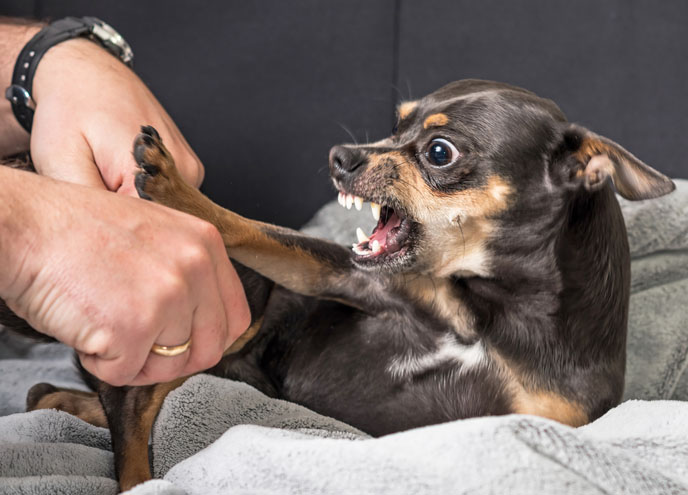
Reactive dogs can be excellent pets, but they come with their issues. A reactive dog reacts improperly to a specific scenario or stimuli (in our opinion). Dog trainers may classify your dog as reactive if they are unfriendly to other dogs, dislikes strangers, or has difficulty coping in specific settings.
Dog reactivity occurs in a variety of shapes and sizes. It shows up as barking, leaping, and even biting at the spectrum’s extremes. However, there is also screaming, hiding, shaking, panting, pacing, increased heart rate, and complete shutdown.
Men with beards, large canines, and bicycles are just a few of the things that cause reactivity in certain dogs. Others are simply scared, nervous, or irritated, but there can be a variety of reasons for this, as well as more than one reason at times.
We can’t make our dog can’t better by scolding him. It will only make him uneasy if you chastise him for exhibiting his stress by barking, lunging, or snarling. If you chastise him, in his perspective, the issue is critical!
Also Read: Why Does My Dog Bark and Lunge at Other Dogs
Table of Contents
What Is Causing My Dog’s Increased ReDog’sity?
Have you noticed that as time passes, your dog becomes more reactive? You may have attempted various strategies to lessen his reactive reactions, but he seems to intensify and “go insane” at an “increasing” rate. Look for the following signs:
- Stiff Tail
- Stiff Body
- Stare in a way that you won’t be able to swon’tThe dog is incapable of responding to simple stimuli (such as his name, Come or Sit)
- The dog is putting a lot of strain on the leash.
When your dog regularly exhibits these behaviors when walking, you must get the signal that he is too nervous to grow less reactive.
Placing him in circumstances like this regularly will only exacerbate his response. There are far too many variables to address in a single blog post, but here are some of the most typical causes of reactivity.
Breeding Issues
Cortisol, a stress hormone, can cross the placenta from mother to pup before the pup enters this world. Mothers of pups from puppy farms are frequently upset. Poor pups are born with the ability to become more anxious or reactive later in life.
A socialization
The value of exposing young puppies to various products, environments, people, animals, and circumstances cannot be overstated.
This must be done gently, without causing anxiety in the puppy, and it must begin before the puppy reaches the age of four months, as this is the time when the brain is most susceptible to new experiences.
The majority of the labor, however, should be done by the breeder before the puppy arrives at your home. It is critical to seek out reliable breeders who have detailed puppy-rearing programs.
Agony
A comprehensive vet check is always the first step in teaching your reactive dog. It’s a fact that if it is in discomfort, it will react more aggressively.
Isn’t it true that if you’re sick, your sensityou’ref your dog was injured in the first place due to an accident, they may become hypersensitive to an object, an animal, or a location linked with the accident? For example, being bitten by a large dog may cause your pet to become reactive to all large dogs, not just the one who bit him.
A Sudden Change in Environment
This is a socialization offshoot. Suppose your puppy or dog is unexpectedly thrown into a new area, presented with a new kind of animal, or startled by a loud noise.
In that case, they will learn to link unknown things with dread if the situation is not handled gently and with assistance. It’s critical to tIt’s your dog to be attentive and adaptable.
Inhumane Treatment
A dog mistreated or chastised in the past will develop a negative association with people. Traditional dog training practices were cruel to dogs and may be to blame for various behavioral issues.
If something is seemingly harmless, such as yelling at a sensitive dog who has peed on the floor, it can induce enormous stress and anxiety in their carer, making them feel unprotected at a time when they are most in need of assistance.
Also Read 5 Reasons Your Dog Won’t Stop Barking
Once the vet has determined no scientific explanation for the behavior, the first step in helping a reactive dog is reestablishing its internal stress management system.
We normally advise abstaining from all triggers completely. For a few weeks, this could entail limited or no walks. This is referred to as a cortisol vacation. Substitute loads of cerebral stimulation at home for the walks. Other helpful hints for keeping reactive dogs quiet are as follows:
Block Your Dog’s Visuals
When dogs are out strolling, you’re at home. Practice restricting your dog’s vision. If your dog’s been taking you for a run outside, you should stop unless you’re with him.
Your dog’s access to windows or attempt a simple repair like putting wax paper on the glass if your dog is frightened of them. This lets light in while reducing the visual impact. Discovering a solution to stop your dog from jumping over the fence would be best.
Allowing your dog to fence-run is not a good idea. If you can not stop it, take your dog to the backyard so the house blocks any triggers on the street. Indoors, use gentle, calming music and white noise sources like fans to drown out outside sounds.
Assist Your Dog in Feeling Safe
When your dog is secure, he will cease attempting to chase things away.
Nothing should be Left to Chance.
If you’re not confident about how your dog will respond to doing something, such as your brother’s new rescbrother’s lovely new puppy on the trail, wait for a little before introducing them. Bide your time, or stay away from it all whole.
De-sensitize the Triggers by counter-conditioning them.
Note the items that make your dog react in a certain way. Place the most severe ones at the top of the list. Find your way through the list by coupling the trigger with something enjoyable. Ding a collar gently from a distance while giving your dog exceptionally high-value dog goodies so your dog can hardly detect it.
That is what you match with a trigger, whatever your dog’s favorite the dog’s. It is often referred to as an open bar. Food is free-flowing as long as a jingle is heard. When the jingle stops, the food stops, and the pub closes.
Among the most typical triggers include barking, doorbells, and automobile doors. Are there any other things that irritate your dog? When your dog has crossed his limit, he will refuse to eat.
To assist your dog in adjusting his passionate response to the triggers, coupling them with something pleasurable. This will take some time, and you must prepare ahead of time. It takes time, but it must be completed.
Your dog will require good experiences at a comfortable distance under the threshold to counterbalance this response. The length at which your dog does not react while under the threshold differs for each dog.
Learn to read your dog’s delicate boddog’s clues so you can assist him to stay on the right side of the door. Your objective is to progressively pull the trigger closer to your dog from a safe distance until he is under the threshold. Training in behavior modification can be beneficial.
Teach something Special to Your Dog.
After you’ve counter-conyou’veed to other dogs, you should concentrate on hand-targeting, tugging, and paying attention. When a dog appears, your dog will try to look at you instead of leaping and barking at it.
How to Train a Reactive Dog?
Training a reactive dog requires tolerance, time, and cautious control. Dog training classes are not the ideal environment for a reactive dog, we can’t stress this can’th. It’s simply too much for them to handle everything at once.
They will not “get accustomed to “it,” and the issue will “only worsen. Introducing a reactive dog to a training session is like throwing a box of spiders into the lap of an arachnophobe.
Reactive dog training should always be peaceful, regulated, and suited to the dog’s needs. Reactive dogs may be able to move to a scent work class or similar. But this is a long-term aim, not a launching point. A detailed evaluation with a certified dog behaviorist should be the first step in training your reactive dog.